

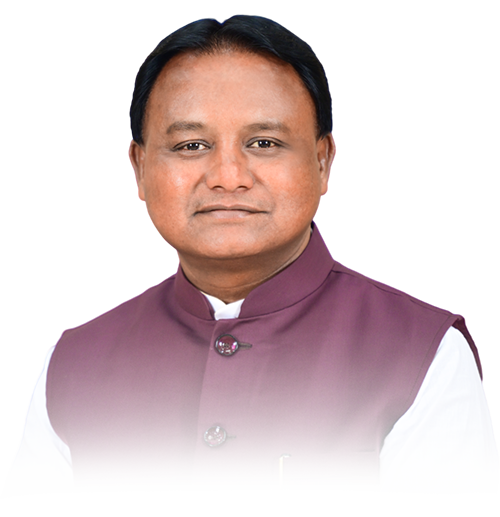
Shri Mohan Charan Majhi Hon'ble Chief Minister



The Centrally sponsored scheme “Establishment of an Agency for Reporting Agricultural Statistics”(EARAS) is in operation in the state through Directorate of Economics & Statistics, Orissa since 1976-77. With a view to cover all revenue villages of the state within a period of five years, 20% villages are covered in each agricultural year with effect from 1981-82 on non-overlapping basis. Under the scheme Land Utilisation Survey (LUS) and Yield Estimation Survey (YES) are carried out in each crop season of an agricultural year.
FOD is responsible for all activities including survey design, field operations, data processing and preparation of reports under the ICS scheme.
In Odisha, it was introduced during 1976-77 covering 6% of the villages which subsequently increased to 10% in 1977-78 and 20% level in 1981-2 onwards.
For this purpose, each Community Development Blocks has been considered as a stratum.
| Sl. No | Datasets Name | Cost |
|---|---|---|
| 01 | Ears Back Year_Dist wise Price data | Free |
PMFBY is an agricultural insurance scheme launched by the Government of India in 2016 to provide financial support to farmers in case of crop loss due to natural calamities, pests, and diseases. The scheme aims to stabilize farmers' income and encourage sustainable farming practices.
Farmers apply through banks, CSCs, or online portals, paying a subsidized premium (2% for Kharif, 1.5% for Rabi, and 5% for commercial crops), while the government covers the rest.
Losses are evaluated using Crop Cutting Experiments (CCEs), remote sensing, and technology-driven methods. Claims are settled via Direct Benefit Transfer (DBT) into farmers' bank accounts.
The scheme is executed by insurance companies, with oversight from the central and state governments, ensuring transparency and timely payouts.
| Sl. No | Datasets Name | Download Documents |
|---|---|---|
| 01 | PMFBY Kharif Paddy-2016 |  |
| 02 | PMFBY Kharif Paddy-2017 | |
ICS is a data collection process used to estimate the cost of agricultural inputs such as seeds, fertilizers, pesticides, labor, and machinery. The survey helps in determining the overall cost of cultivation and is crucial for policy decisions, including minimum support prices (MSP) and crop insurance schemes like PMFBY (Pradhan Mantri Fasal Bima Yojana).
Conducted through field surveys and structured questionnaires, collecting data on expenses like seeds, fertilizers, pesticides, labor, irrigation, and machinery from farmers
Costs are categorized into fixed (land rent, machinery depreciation) and variable (input costs, labor, irrigation, etc.), helping determine per-hectare cultivation costs.
Data is used for setting Minimum Support Price (MSP) and in PMFBY to decide the sum insured and claim compensation for crop loss.
| Sl. No | Datasets Name | Download Documents |
|---|---|---|
| 02 | Datasets Name Here | |
| 02 | Datasets Name Here | |
| 03 | Datasets Name Here | |
The Agriculture Census is a large-scale survey conducted in India to collect data on the structure of agriculture, including land holdings, land use, tenancy, and input usage. It helps in policymaking, resource allocation, and assessing the impact of agricultural reforms.
Conducted in three phases: first using land records, second through field surveys for operational holdings, and third for detailed input usage data
Land holdings are categorized by size, ownership, tenancy, and usage to analyze trends in agriculture
Data helps in shaping policies on land reforms, subsidies, credit support, and agricultural development programs.
| Sl. No | Datasets Name | Download Documents |
|---|---|---|
| 01 | Datasets Name Here | |
| 02 | Datasets Name Here | |
| 03 | Datasets Name Here | |
ALWS collects data on the wages of different categories of agricultural laborers across regions. It helps in analyzing wage trends, employment conditions, and rural livelihood patterns. The survey gathers information on daily wages for activities like plowing, sowing, harvesting, and irrigation, considering factors like gender, crop season, and region. The collected data is used for fixing minimum wages, formulating labor welfare policies, and assessing the impact of inflation on rural workers. It plays a crucial role in government planning for rural employment schemes and wage regulations.
Wages of agricultural laborers are gathered through field surveys, local authorities, and official records, covering different farm activities like plowing, sowing, and harvesting.
Wages are categorized based on gender, region, type of work, and crop season to analyze wage disparities and labor conditions.
The data helps in setting minimum wages, formulating labor policies, and evaluating the impact of inflation on rural workers.
| Sl. No | Datasets Name | Download Documents |
|---|---|---|
| 02 | Agriculture labour wages survey 1 | |
| 02 | Agriculture labour wages survey 1 | |
The MI Census is conducted to collect data on small-scale irrigation sources such as wells, tube wells, tanks, ponds, and check dams. It helps in assessing the availability, usage, and impact of minor irrigation on agricultural productivity. The census covers both groundwater and surface water irrigation systems, along with ownership patterns and energy sources used (electric, diesel, solar). The collected data aids in policy planning, water resource management, and infrastructure development for sustainable irrigation. It plays a crucial role in improving farmers’ access to water and enhancing crop yields.
Information on groundwater (wells, tube wells) and surface water (tanks, ponds, canals) irrigation sources is gathered through field surveys and local administrative records.
Irrigation structures are categorized based on type, ownership, water source, energy usage (electric, diesel, solar), and command area to assess their impact on agriculture.
The data helps in water resource management, infrastructure development, and formulating policies for sustainable irrigation and farmer support.
The Census of Water Bodies is conducted to collect comprehensive data on lakes, ponds, tanks, reservoirs, and other water bodies across India. It aims to assess their size, condition, ownership, usage, and encroachment status. The census covers both natural and man-made water bodies, providing insights into their role in irrigation, drinking water, fisheries, and groundwater recharge. The data helps in water conservation planning, policy formulation, and sustainable management of water resources. It plays a crucial role in addressing water scarcity, climate change impacts, and rural development.
Information is gathered through field surveys, satellite imagery, and administrative records, covering lakes, ponds, tanks, reservoirs, and other water bodies across rural and urban areas.
Water bodies are categorized based on type (natural/man-made), size, ownership (government/private), usage (irrigation, drinking, fisheries), and encroachment status to assess their condition and utility.
The collected data helps in water conservation strategies, sustainable management, policy formulation, and initiatives for restoring and protecting water resources.


